Project
Bows & Arrows Creations
Designer and Developer
Website for a small home based business offering custom cakesicles and hand painted banners in Middle Tennessee.
Next.js · React · TypeScript · Vercel · Resend · PostHog
Overview
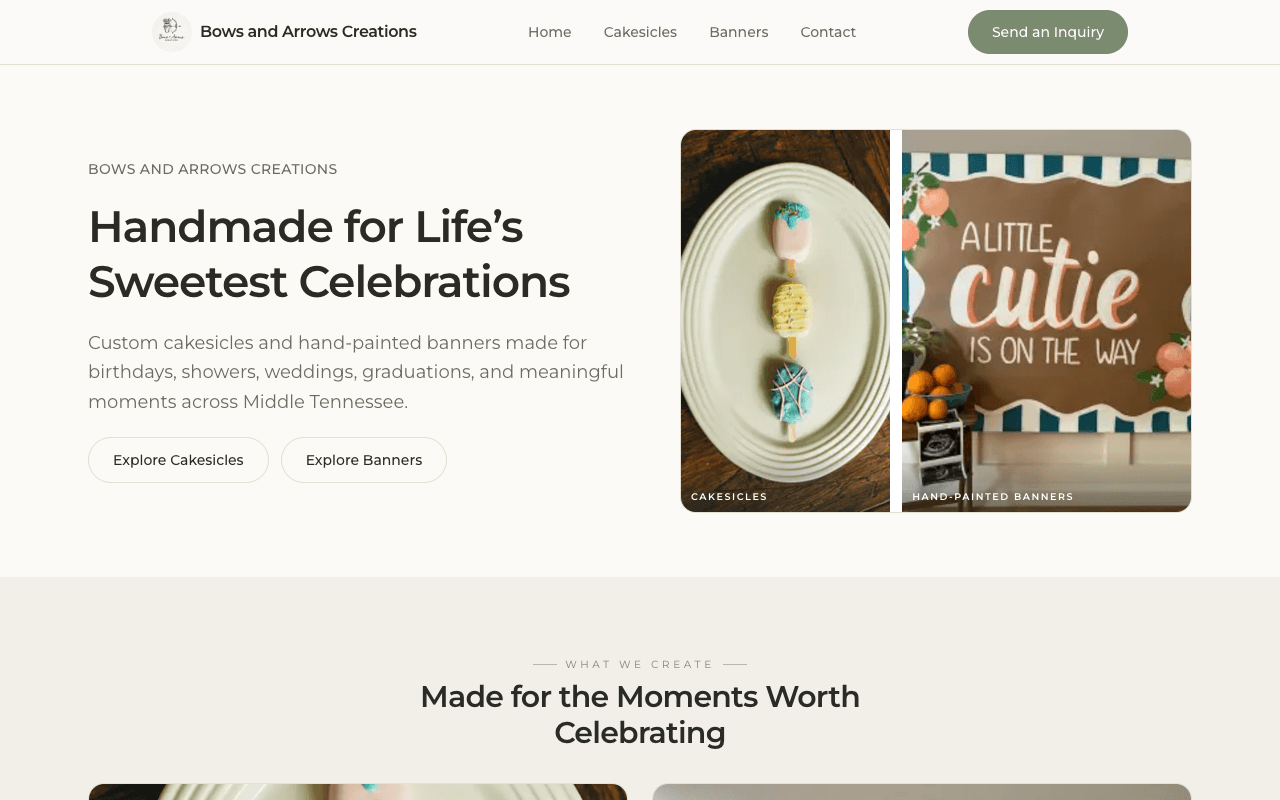
Bows & Arrows Creations is a small home based business in Middle Tennessee offering custom cakesicles and hand painted banners.
I designed and built the website to give the business a professional online presence, make the products and pricing easier to understand, and create a new way for customers to discover the business and start an order.
The problem
Before the website, most new business came through Facebook referrals and word of mouth.
That worked, but it meant nearly every customer interaction started with a conversation. Customers needed to ask what was available, how much something cost, what could be customized, and how to place an order.
The goal was to create a website that could answer those questions before someone reached out while still keeping the personal ordering process that works well for a small custom business.
Building around the actual business
One of the more important decisions was what not to build.
Most orders are customized around a specific event, quantity, theme, color palette, date, packaging request, or design. A traditional ecommerce checkout would have forced those orders into a process that did not match how the business actually operates.
Instead, I built the site around inquiries. Customers can explore the products, see examples of previous work, understand pricing and options, and then submit the details of what they are looking for. From there, the business can review the request and continue the conversation directly with the customer.
It keeps the experience simple without trying to automate a part of the process where a real conversation is still useful.
Making pricing easier to understand
A large part of the site was making sure customers could understand what they were buying before submitting an inquiry.
For cakesicles, that meant clearly presenting the available options, minimum quantities, packaging, and pricing. I also built an interactive pricing calculator so customers can get a better idea of what an order will cost based on what they select.
The goal was not to replace the final quote. It was to remove uncertainty and give someone enough information to know whether the product fits what they are looking for.
Designing for more than one type of event
The business serves more than children's birthday parties. Cakesicles and banners can also be used for weddings, showers, anniversaries, adult birthdays, and other events, so I wanted the visual direction to feel broad enough for all of them.
The site uses a clean and restrained interface with the products and photography doing most of the visual work. The goal was to make a small home business feel professional without losing the personality behind it.
Creating a new acquisition channel
The website also gave the business a way to reach customers outside of its existing referral network.
Instead of relying only on Facebook and word of mouth, customers can now discover the business online, understand what it offers, and submit an inquiry directly through the site.
PostHog data has shown that real visitors are using those inquiry flows, giving the business a new path from discovery to an actual customer conversation.
Engineering
Next.js · React · TypeScript · Vercel · Resend · PostHog
I handled the design, development, deployment, domain setup, analytics, and customer inquiry workflow. Inquiry submissions are handled directly through the site and delivered by email, keeping the implementation lightweight while still supporting the way the business operates.
What I learned
Building the right product does not always mean building more software.
The business did not need customer accounts, a shopping cart, or a complicated ordering system. It needed a professional way for customers to understand what was available, get comfortable with the pricing, and start a conversation.
A lot of the work came down to deciding where software could remove friction and where keeping a person involved created a better experience.
Sometimes the best product decision is knowing what not to build.
Interested in how I approach product engineering?
Get in touch →