Project
CarShow Coordinator
Founder and Product Engineer
Platform for car show organizers and drivers to manage events, registration, vehicles, classes, judging, and awards in one place.
Next.js · React · TypeScript · PostgreSQL · Prisma · Vercel · Resend · Mapbox · PostHog
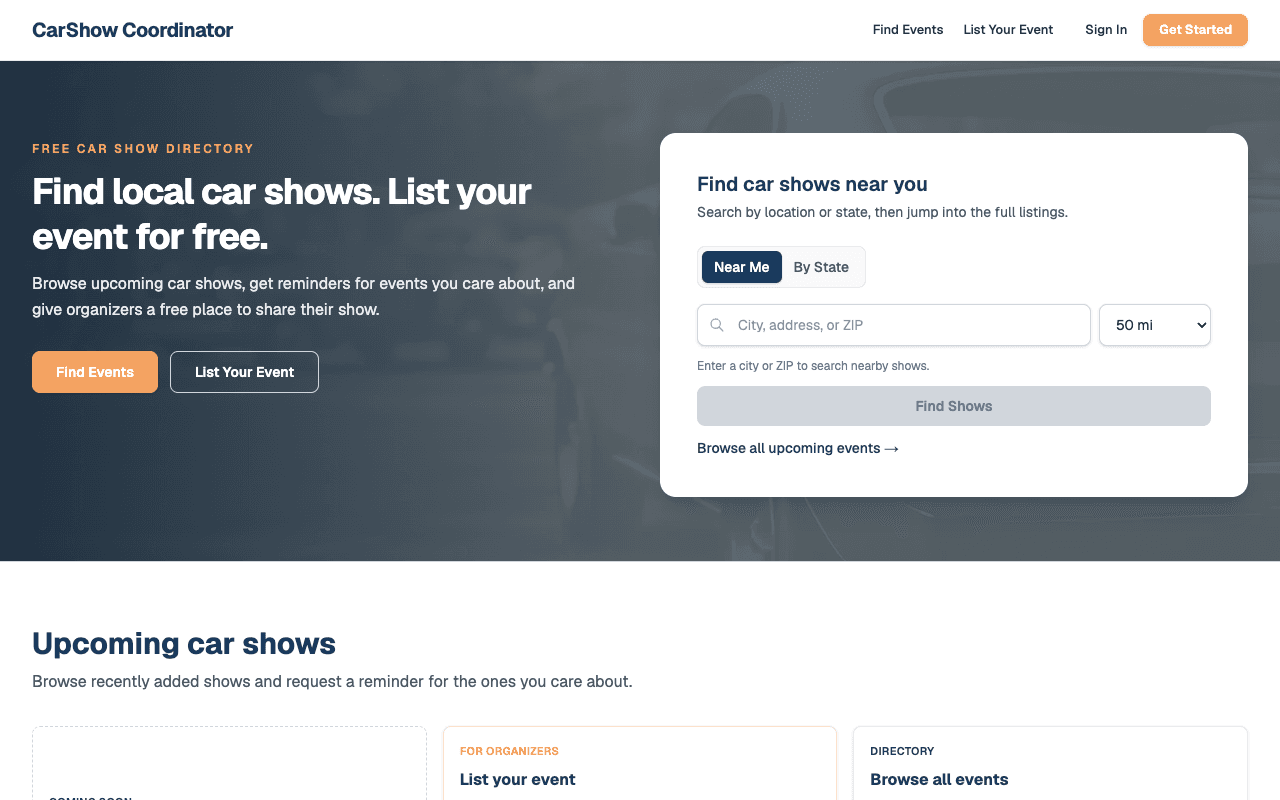
Overview
CarShow Coordinator is a platform for car show organizers and drivers to manage events, registration, vehicles, classes, judging, and awards in one place.
What started as a way to fix a frustrating registration process eventually became a full product built around the actual workflow of running a car show.
Where it started
CarShow Coordinator came from a nonprofit my wife and her family started in memory of her father. He loved cars, so one of the events they created was an annual car show.
The first show brought in around 200 to 250 cars.
Registration was almost entirely paper based. Lines were long, handwriting was difficult to read, and the volunteers at the registration tent sometimes had to identify vehicles they were not familiar with before figuring out where they belonged.
It worked, but there was a lot of unnecessary friction. I started looking for ways to make that process easier.
The first version
The following year I built a custom online registration form into the existing WordPress site and connected it to Google Forms and Google Sheets.
Instead of collecting everything by hand on the morning of the event, organizers could already have structured information about the driver and vehicle before the car arrived.
That solved the registration problem, but it exposed the next one. Once the cars were registered, we still had to sort roughly 200 vehicles into judging classes quickly and accurately.
Building around the real workflow
The next version focused on class assignment and judging. I added systems around the spreadsheet that helped organize vehicles into classes, group them correctly, and make the judging process easier to manage.
At that point I still saw it mostly as software for our event. Then the head judge told me it should be its own product and that he would use it for other shows.
That was the point where I started thinking beyond our event and turned the workflow into CarShow Coordinator.
From a spreadsheet to a platform
The product now brings the major parts of a car show into one system:
For coordinators
Event management, registration, vehicle review, class assignment, judging, scoring, and awards.
For drivers
A simpler way to find events, register vehicles, and participate without relying on paper forms or event day guesswork.
Thinking about both sides
Coordinators are the primary customer, but I think about both sides of the experience. A coordinator only benefits from the platform if drivers are also willing and able to use it.
Project: Class assignment
The part of the product I am most proud of is the class sorting system.
Car shows can have dozens of classes, and the rules for deciding where a vehicle belongs can overlap. A car might match several different criteria depending on its make, model, year, modifications, or type.
I built the sorting logic around a concept similar to CSS specificity. More specific class rules take priority over broader matches, allowing the system to determine the strongest available class for a vehicle instead of relying entirely on manual sorting.
The goal was not to remove the coordinator from the process. It was to handle the obvious decisions automatically and make the remaining decisions easier to review.
Project: Learning from the actual event
What looked good in design
The first version of the class management interface looked good when there were only a handful of classes.
What broke under real use
Once we used it with a real show and the class count grew past roughly 20, it became difficult to work with. Vehicles that were categorized incorrectly needed to be corrected quickly, and the interface was slowing that process down.
What changed
I changed the experience to use simpler horizontal class rows with drag and drop controls so coordinators could see more information at once and move vehicles between classes quickly.
What it reinforced
A workflow can make perfect sense while you are designing it and still fall apart once someone needs to use it under real conditions.
How I approach the product
CarShow Coordinator has never really been built from a feature list. Each stage came from watching the previous version get used:
- Paper registration led to online registration.
- Online registration exposed the class sorting problem.
- The spreadsheet workflow exposed the need for a dedicated application.
- The first application exposed problems with how classes were presented and managed.
- Every version has made the next problem easier to see.
What that process taught me
That process has shaped how I think about product engineering. I try to get something useful in front of real users, pay attention to where the friction actually is, and improve the product based on what happens rather than what I assumed would happen.
Engineering
Next.js · React · TypeScript · PostgreSQL · Prisma · Vercel · Resend · Mapbox · PostHog
I designed and built CarShow Coordinator across the full product stack, including the product experience, frontend, backend, database, infrastructure, email workflows, analytics, and deployment.
What I learned
A good product often starts with a very ordinary problem.
I did not start out trying to build a software company. I was trying to shorten a registration line and make a family event easier to run. The product grew because solving one real problem exposed another.
It has also taught me the value of sticking with a problem long enough to understand it. CarShow Coordinator has evolved over several years, and each real event has challenged assumptions I had about how the product should work.
My goal is not to build the most features. It is to keep removing the parts of running a car show that should not be difficult.
Interested in how I approach product engineering?
Get in touch →